
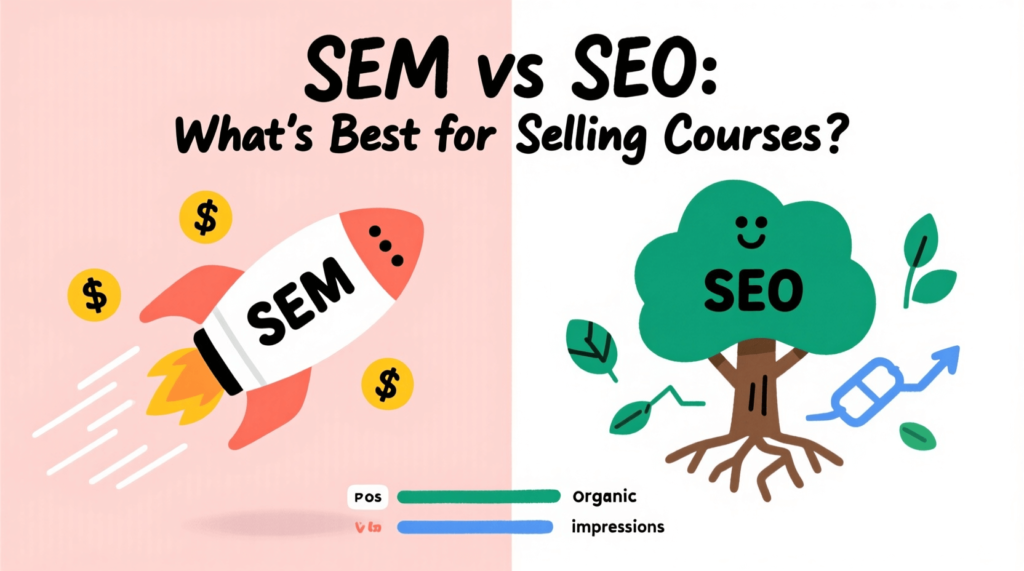
For course sales, Search Engine Marketing (SEM) provides immediate traffic and short-term results through paid ads, while Search Engine Optimization (SEO) builds long-term, cost-effective, organic visibility and trust. The best strategy for a course creator often involves using a blend of both.
SEM: Immediate visibility and targeted reach
SEM, which primarily uses paid advertising like Google Ads, is a sprint designed for quick, measurable results.
Pros for course sales
- Immediate traffic: Your course ads can appear at the top of search results almost instantly after a campaign launches, driving quick traffic to your landing page. This is ideal for a new course launch or a limited-time promotion.
- Precise targeting: You can target potential students based on specific keywords, demographics, interests, and past behaviors, ensuring your ads are seen by the most relevant audience.
Read our blog on Keyword Research for Online Courses at RankMyCourse and learn simple ways to reach more students.
- Measurable results: SEM provides immediate data on impressions, clicks, cost-per-click (CPC), and conversions, allowing you to quickly test different ad copy and landing pages to see what works best.
Read our blog on SEO for Course Landing Pages at RankMyCourse and learn how to attract more students easily.
- High conversion potential: Since you can target users who are actively searching for a solution, SEM can generate highly qualified leads who are more likely to convert into paying students.
Cons for course sales
- Ongoing cost: SEM requires a continuous budget. Your course’s visibility and traffic will cease the moment you stop paying for ads.
- Higher expense: Bidding on competitive keywords can be expensive, and your ad costs will increase with more competition.
- Audience perception: Some users are wary of ads and may trust organic search results more than paid listings.

SEO: Long-term growth and credibility
Pros for course sales
- Long-term, sustainable traffic: A strong SEO foundation provides a steady stream of traffic for months or even years with minimal ongoing investment. A blog post optimized with evergreen content can continuously attract new students.
- Credibility and trust: High organic rankings are often seen as a mark of authority and can build significant trust with potential students.
- Cost-effective over time: While SEO can have high initial costs related to content creation, it becomes more cost-effective in the long run as organic traffic grows without additional ad spend.
- Higher click-through rates: Organic search results often have higher click-through rates than paid ads because users trust them more.
Cons for course sales
Get Your Course Ranked Today!
Make sure your course stands out in search results. Get more visibility, attract students, and increase enrollments with expert SEO strategies.

Combining SEM and SEO for maximum course sales
For the most effective and sustainable growth, course creators should integrate both SEM and SEO into a unified digital marketing strategy.
- Use SEM for a quick launch: When you first launch a course, use SEM campaigns to generate immediate traffic and sales while you wait for your SEO efforts to gain traction.
- Leverage SEM data for SEO: Use the data from your paid campaigns to discover which keywords and messaging are most effective. Then, apply those insights to your SEO strategy, creating optimized content around high-performing keywords.
- Build long-term content from SEM insights: If an SEM ad on “how to start a marketing agency” performs well, create a detailed, optimized blog post on that topic to build organic traffic over time.
- Retarget with SEM: Use SEM to create remarketing campaigns that target users who have visited your course page organically but haven’t purchased yet.
- Own more search real estate: By ranking for a keyword organically and running a paid ad for it, you can dominate the search results page, boosting visibility and brand authority.
FAQ
1. What is your budget and timeline for course enrollment?
- SEO: This strategy is ideal if you have a longer timeline and a smaller budget, as it focuses on building organic, long-term traffic that doesn’t require continuous spending on ads.
- SEM: Choose this if you need to drive immediate traffic and enrollments for a new course launch, a promotional period, or a high-competition field. It requires a consistent ad spend but provides instant visibility.
2. How much content and authority does your brand already have?
- SEO: If you have an established brand with high-quality, relevant content (like blog posts, videos, or guides), an SEO strategy can leverage this to build authority and earn higher search rankings.
- SEM: If you are a new course creator with no existing authority or content, SEM allows you to bypass the long process of earning organic rankings and get your course in front of your target audience immediately.
3. What is the level of competition for your course’s keywords?
- SEO: It can be very difficult and time-consuming to rank organically for highly competitive, high-traffic keywords. SEO is best for targeting long-tail, niche keywords that a smaller, more dedicated audience is searching for.
- SEM: Paid ads are often the best way to get visibility for highly competitive keywords. SEM lets you bid on these high-traffic terms and appear at the top of the search results, even if your organic ranking is low.
4. What is the purpose of your search presence?
- SEO: Use SEO to establish your brand as a credible, educational leader in your niche. The goal is to build a trusted resource that provides value to potential students beyond just selling them a course.
- SEM: Use SEM to focus on direct conversion and lead generation. This is a transactional approach that targets users who are further down the sales funnel and ready to buy.
5. How will you use SEM and SEO together to maximize results?
- Combined Strategy: The most effective approach for online course sales is to use both. Launch with SEM to generate immediate buzz and valuable data on keywords and ad copy. Then, use that data to refine your SEO content strategy for long-term, sustainable growth. Use remarketing with SEM to target users who found your site through an organic search but didn’t convert.